Wildlife
Two Kinds of Slow: How to Spot a Sloth Around Cahuita
Most people look for a face, or for movement. A sloth is neither. It is a shape in the wrong place, and it stays there.
· 6 min read
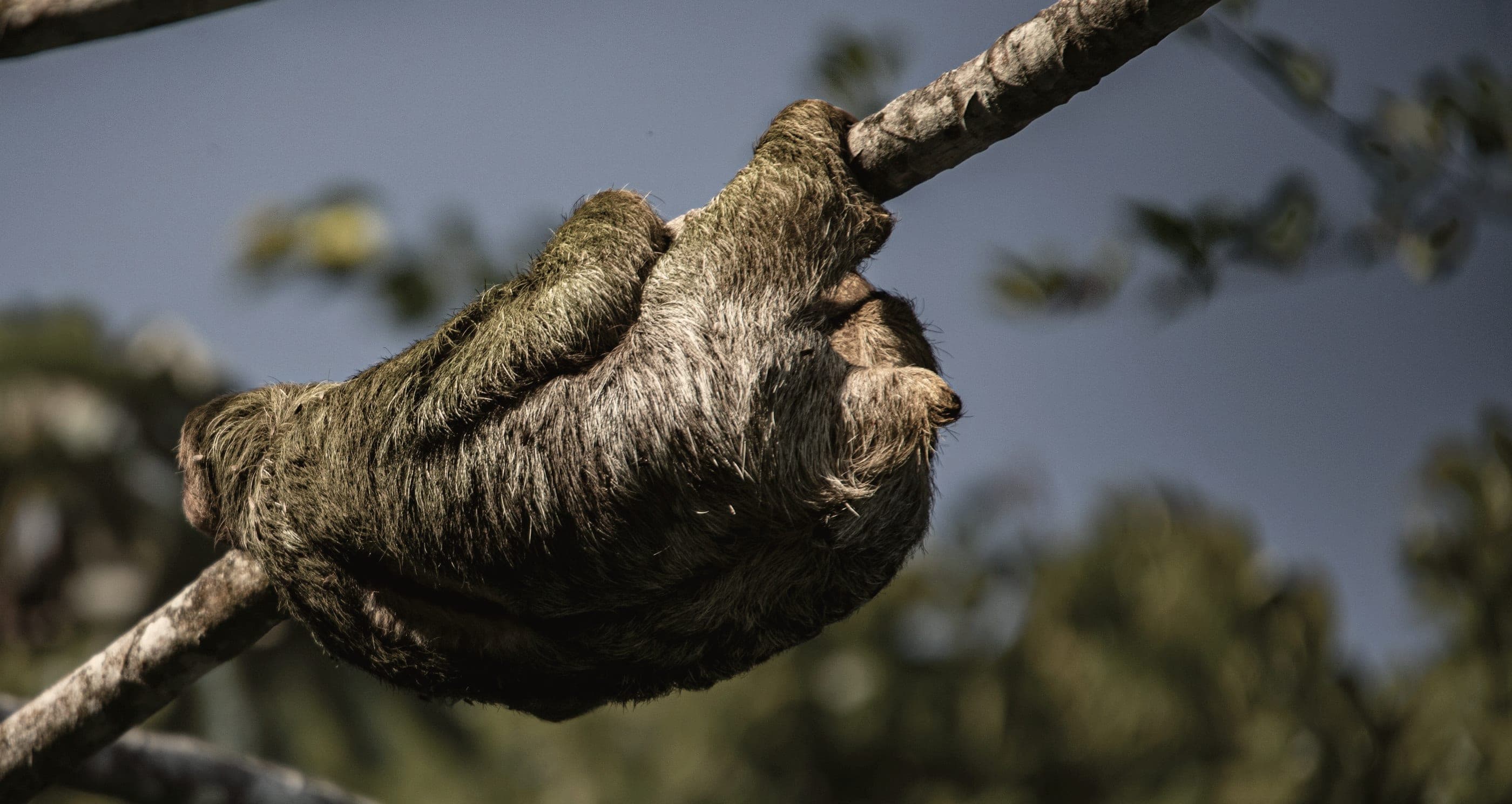
A sloth does not read as an animal from below. It reads as a termite nest. Or as a clump of dead leaves caught in a fork. That is the whole method. Stop scanning for a face. Scan for a lump in the wrong place, then wait to see whether the lump has an outline.
Two species live around Cahuita. The old names are three-toed and two-toed. Three-fingered and two-fingered is the more accurate pair. Both species carry three claws on the hind feet. The count that separates them sits on the front feet.
Bradypus variegatus
The brown-throated three-fingered sloth. Greyish-brown fur, a pale face, a dark stripe running back through each eye like a mask. The corners of the mouth turn up, so every photograph comes out as a smile. It is bone, not mood.
This is the one most people see, because it is awake in patches through the day as well as the night. Sleep takes fifteen to eighteen hours out of every twenty-four, and the rest is spread thin. Afternoon is the better half of the day for looking.
The neck is the giveaway. Bradypus carries extra vertebrae there, more than the seven almost every other mammal gets. The head turns roughly three quarters of a circle. On a still afternoon the body stays welded to the branch and only the head comes round. That small rotation is what breaks the shape and tells the eye it is looking at an animal.
Choloepus hoffmanni
Hoffmann's two-fingered sloth. Bigger, shaggier, a longer snout, almost no dark markings on the face. Two claws on the front feet instead of three.
It works at night, moving through the canopy for about eight hours. During the day it is usually a ball wedged in a fork. The ball is what gets photographed and misidentified. Its neck is ordinary, about six vertebrae, and the head turns about a quarter circle. So a head that swivels far is a Bradypus. A head that barely turns, on a larger and scruffier animal, is a Choloepus.
| Three-fingered | Hoffmann's two-fingered | |
|---|---|---|
| Species | Bradypus variegatus | Choloepus hoffmanni |
| Front claws | 3 | 2 |
| Face | pale, dark stripe through each eye, upturned mouth | longer snout, few dark markings |
| Size | 42–80 cm, 2.25–6.3 kg | 54–72 cm, 2.1–9 kg |
| Awake | day and night, most active roughly noon to 6pm | night, about 8 hours of movement |
| Head rotation | about 270° | about 90° |
| Sleep | 15–18 hours a day | mostly by day |
| Lifespan | about 30–40 years outside captivity | up to 43 years recorded in captivity |
| IUCN status | Least Concern | Least Concern |
The Cecropia
The standard line is that sloths live in Cecropia trees. It is a myth, and it has a plain cause. Cecropia has an open, umbrella-shaped crown with few leaves in the way. A sloth in one is visible from a road. A sloth in a dense crown is invisible from anywhere. The tree is not a preference. It is a window.
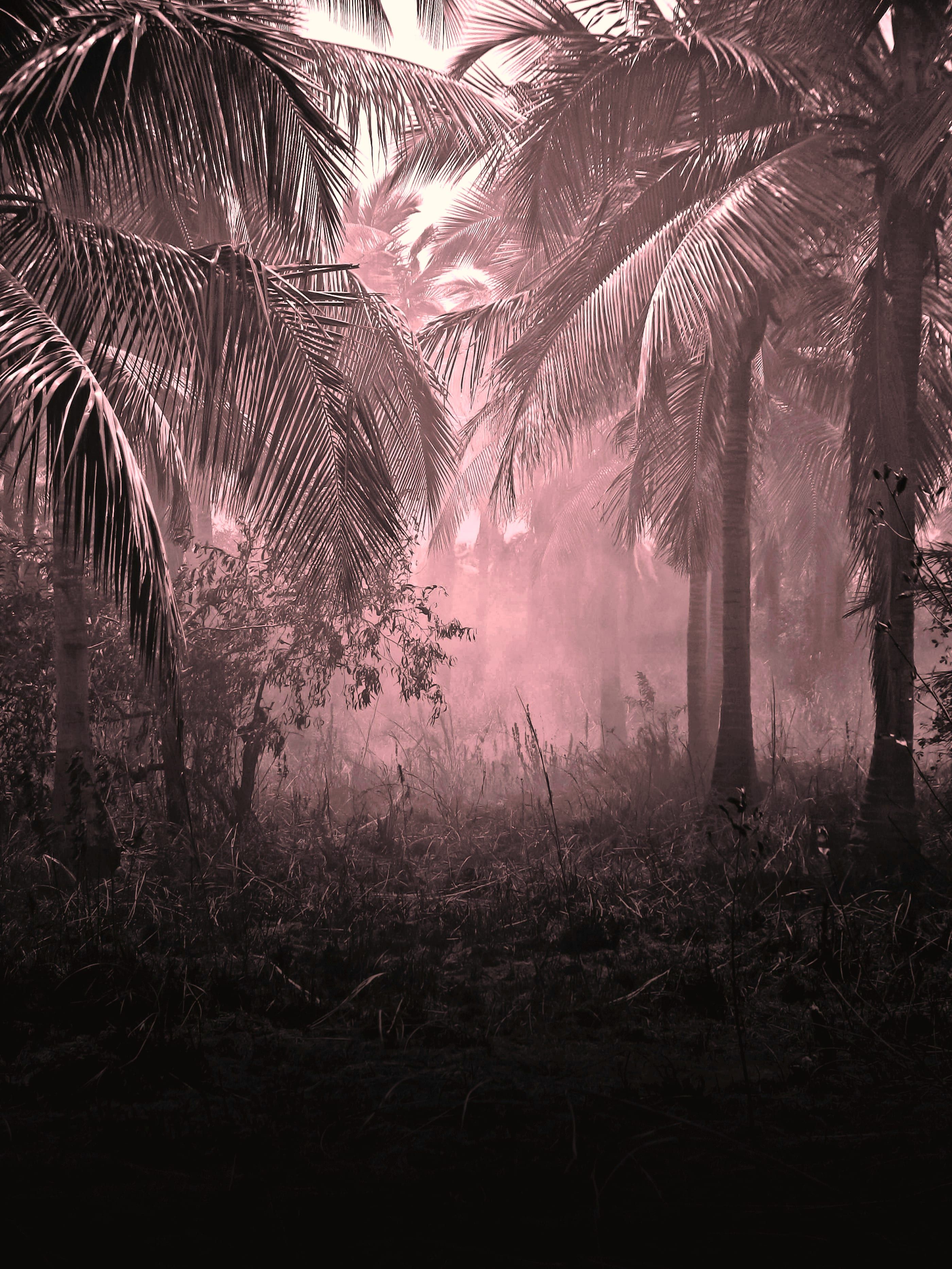
A dense palm canopy in mist. The hard half of the sample looks like this, a dark crown where nothing moves.
Radio-tracking work going back to the 1970s followed the animals out of that visible sample. Sloths have been recorded feeding on more than ninety tree species. They are generalists.
The Sloth Conservation Foundation, which works along this coast, adds the other half. On a Costa Rican cacao farm, sloths with more Cecropia inside their home range survived better and bred better. That study ran in Proceedings of the Royal Society B. Cecropia is one good food tree among many, and having it nearby helps. It is just not a diet.
For finding one, the practical version is short. Check the Cecropia first because it is easy. Then stop, and start reading the dense crowns for shapes, because that is where most of them are.
Jonathan Pauli's moths
Three-fingered sloths come down from the canopy about once a week to defecate at the base of their tree. Everything else about the animal is built for staying up. The climb down and back costs an estimated eight percent of a day's calories. More than half of recorded sloth deaths are tied to predation on those trips. It is the single most expensive thing a sloth does, and it does it on schedule.
Jonathan Pauli is an ecologist at the University of Wisconsin-Madison. He led a study on a Costa Rican cacao farm looking at why. Fourteen two-fingered and nineteen three-fingered sloths, published in Proceedings of the Royal Society B in 2014. His team found sloth moths living in the fur. Cryptoses, up to about a hundred and twenty on a single animal. The moths lay their eggs in fresh sloth dung. The larvae feed on it. The adults fly up into the canopy and settle back into the fur of a sloth.
The proposal that follows is a loop. Moths bring nitrogen into the fur. Nitrogen fertilises the algae, Trichophilus, that grows in the grooves of sloth hairs and turns the coat green. The sloth eats some of that algae and gets fats back out of it. The weekly trip pays for itself.
Julian Monge-Najera does not accept it. His 2021 review in Cuadernos de Investigación UNED makes two points. Bradypus variegatus mostly does not groom itself. And eighty-three percent of gut samples contained no algal remains at all. His reading is duller and harder to argue with. The animals climb down because their ancestors climbed down, and nothing has pushed back hard enough to stop them.
Two papers, the same animal, the same kind of farm. Nobody has settled it.
Route 36
What is settled is what happens when a sloth reaches ground it did not expect. When the coast road was paved, the trees whose crowns used to meet overhead came out. The canopy stopped being continuous. Animals that had never touched the ground started crossing on power lines and on tarmac. There they met electrocution, dogs and cars.
The Sloth Conservation Foundation's Sloth Crossing project strings rope bridges across the busy stretches, about fifteen metres up. The corridor runs from Cahuita through Playa Negra and Puerto Viejo to Gandoca-Manzanillo. The first bridge went up around 2019. By February 2022 there were 114. A later post from the foundation puts the number above 130, and we have not found a more recent count than that.
Camera traps on the bridges have recorded fourteen species using them. Both sloths, mantled howler monkeys, white-faced capuchins, opossums. The ropes are visible from the road, if anyone is looking up instead of at the tarmac.
That is the shape of the thing. An animal that spends thirty years avoiding the ground, brought down once a week by something science still cannot agree on, and once more by a road. The walk down through the jungle to Playa Grande, and the park that starts where the beach ends, are both on the place.