Places
A Gate That Asks: Cahuita National Park and Its Donation Entrance
A park with two entrances and two prices. At one of them there is no fixed fee, and the amount is left to the visitor.
· 5 min read
The park starts where the town stops. Cahuita's street runs out at a gate. Past it the coast belongs to the jungle for the next eight kilometres. The park's other entrance, down at Puerto Vargas, sells a ticket at the door. At this gate there is no price.
Kelly Creek
The entrance at Kelly Creek, on the Playa Blanca side, works on a donation. There is no fixed admission. A local community organisation runs this sector, alongside SINAC, the national parks service.
Visitor guides usually cite around five dollars, roughly a thousand colones. That figure is a suggestion and nothing more. The same guides call it the only donation entrance in the Costa Rican park system. We could not confirm that on an official fee schedule, so read it as unusual rather than unique.
The other gate does have a price. Puerto Vargas sits at the far end of the protected coast. SINAC manages that sector directly and charges for it. Two sectors of one park, two systems.
The park itself is older than the arrangement. It was created in 1970 as the Cahuita National Monument, to protect the reef. It became a national park in 1978, ratified in 1982. The Bribri have lived in this region far longer than either date.
In 1998 a Management Committee, the Comité de Manejo, was formed for the park. Members of local organisations sat with SINAC representatives. The committee formalised the community co-management of the park.
Very little of this is visible on a walk. What a visitor sees is one entrance that asks and one that charges. What sits behind it is a village that decided the park at the end of its street was partly its own.
The sign by the showers
Between 2007 and 2008 the donation system was studied properly. Francisco Alpizar, Anna Norden and Peter Martinsson, working with EfD-Central America, ran a field experiment and a survey at Cahuita. They varied the amount suggested to arriving visitors, from one dollar to six. Some visitors also got a colour map of the park.
What people gave moved with what they were told. Information measurably changed willingness to donate. The finding is dry on paper and blunt in practice. A park with no ticket price lives on how it asks.
The rangers took the practical part. They installed a sign near the park showers, asking people to walk back to the entrance and give on the way out. Rangers reported that it worked. Most visitors arrive at a gate and think about money once. The showers come at the end, when the morning has already happened.
The coastal trail to Puerto Vargas
One trail runs the length of the protected coast, from Kelly Creek to the Puerto Vargas ranger station. It is not a loop. Walking back the same way doubles it. The alternative is a ride waiting at the far end.
The path runs parallel to the beach. Mostly under canopy, mostly flat. The sea is often visible through the trees. Creeks cross it. After heavy rain some of them cross it properly.
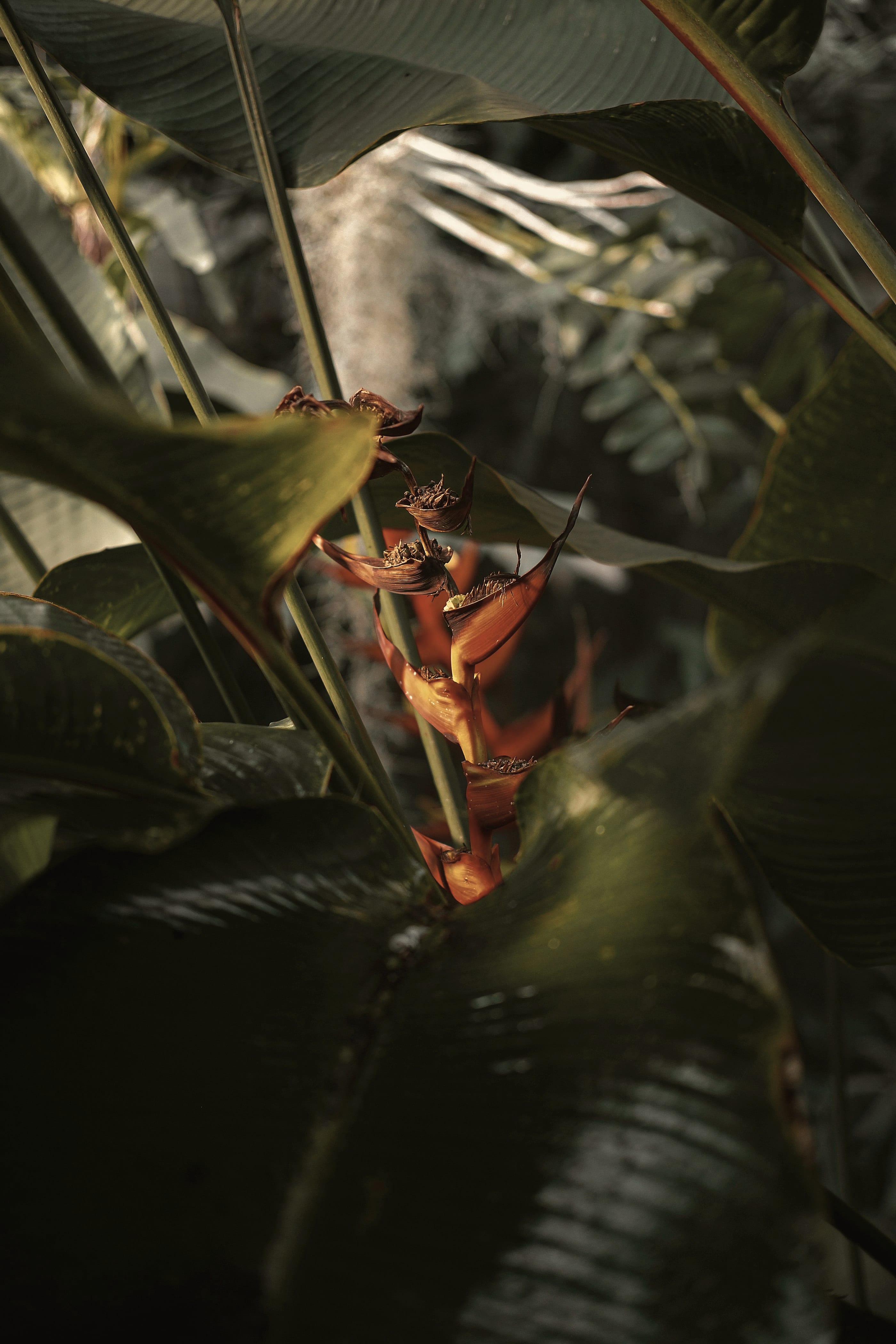
A heliconia in the understory shade. The trail-side planting is this, repeated for kilometres.
What people see: sloths, both the two-toed and the three-toed, high up and not moving. White-faced capuchins, close to the path and entirely unbothered. Coatis crossing at ankle height. Howler monkeys, heard long before anything is seen. Toucans in the crowns. Kingfishers and herons where the creeks meet the sand.
The park, in numbers
Kelly Creek entrance (Cahuita town). Donation, no fixed fee. Community-managed sector.
Puerto Vargas entrance (SINAC). US$5.65 including tax, non-resident adults. ₡1,130 resident adults, ₡565 resident children. Cards accepted.
Coastal trail. About 8 to 8.3 km one way, Kelly Creek to Puerto Vargas. Point to point, not a loop. About 16 km walked both ways.
Park size. Roughly 1,070 to 1,110 hectares of land, plus about 22,300 hectares of sea.
Reef. About 600 acres, outer reef roughly 4 km long, at least 35 coral species.
The outer reef
The reef is the reason the park exists at all. It is also the part almost nobody sees. The marine zone runs to more than twenty times the land area of the park. Counts of fish and molluscs in it pass a hundred species. Some forty-four crustaceans sit alongside them.
The reef has not held. Live coral cover was about forty per cent in the early 1980s. By the early 1990s it was under ten. Sediment did most of it. Runoff came off the farms inland, and the coast itself lifted in the 1991 Limón earthquake. Bleaching events did the rest. Current figures are not something we can state, and we will not guess at them.
That history explains the 1970 date. The monument came first, and the coral was the thing it was drawn around. The sloths and the capuchins are what visitors come for now.
Bothriechis schlegelii
The eyelash viper is small and venomous. It coils on low branches, frequently at about the height of a face, and it does not move when people pass. Guides on the coastal trail look for it and sometimes find it.
Sightings are not common. Sloths and monkeys are seen regularly. A viper is not. What the possibility changes is how a person walks. A snake that sits at eye level rather than underfoot turns the branches beside the path into something to read.
That is most of what the trail does. It is flat. It is easy. It slows people down anyway. Everything worth seeing is still, and nearly the colour of the leaf it is on. The walk back ends where it started. The gate at Kelly Creek asks for a donation and takes whatever is given.
Getting to Cahuita, and what the road does in rain, is on our practical information page.