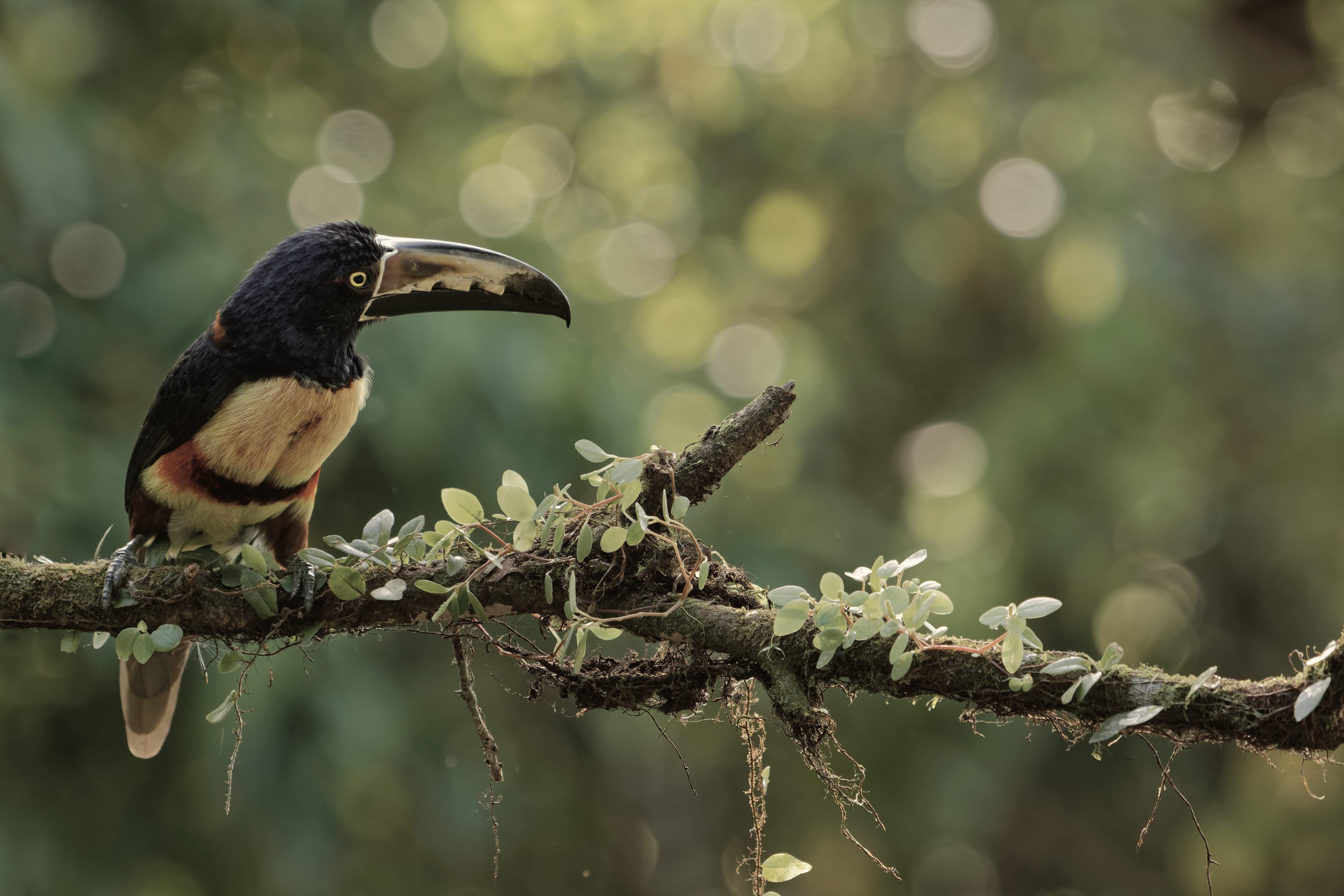
Photo: LG Nyqvist, CC BY-SA 4.0.
Wildlife
Seven to a Hole: The Collared Aracari Around Cahuita
The lodge is named after a bird that travels in company, sleeps in company and raises its young in company. It is rarely alone.
· 5 min read
Most people arrive on this coast wanting the toucan. The heavy bill, the green and the orange, the bird from the coffee packet. The aracari is the other one. Smaller, plainer, and almost never on its own.
It is also the bird this place is named after.
Pteroglossus torquatus
An adult collared aracari runs 38-41 centimetres from bill tip to tail and weighs 175-250 grams. That is a slim bird on a branch, not a heavy one.
The collar in the name is narrow. A band of cinnamon to chestnut across the base of the nape, with red on the lower back, the rump and the uppertail coverts below it. The underparts are mainly yellow. There is a black spot in the middle of the belly and a reddish wash across the breast. The thighs are chestnut.
The bill does most of the identifying work. The upper mandible is pale, from buffy white to a dull reddish brown, with a black tip, a black culmen and black notches. The lower mandible is black the whole way. Two tones, and no green anywhere on it.
The voice is high and sharp and squeaky. The species accounts write it as seek, pseek, pink or penk. There is purring as well, and a rasping grhhrr from a bird that has had enough. Visitors often call the sound a croak. The field accounts do not, so take the croak as an impression rather than a description. Usually the wings arrive before any of it. A group crossing a gap makes an audible whir.
The old woodpecker hole
Aracaris move in flocks of about 6 to 15 birds. The flight is rapid and direct, one bird after another through the same gap in the leaves.
The company does not break up at dusk. Groups roost communally all year in tree cavities, most often old woodpecker holes. Up to seven adults and fledglings have been recorded in a single cavity overnight. The same habit runs through the breeding season. Nesting is cooperative, and the parents can be joined by as many as three extra adult helpers bringing food to the nestlings.
A clutch is usually three eggs, sometimes as many as five. Incubation takes 16-17 days. The young leave the nest 26-30 days after hatching, out of a cavity the birds did not dig themselves.
The fig tree
The diet is mainly fruit. Aroids, Protium, palms, Cecropia and figs, with large insects, small lizards, and the eggs and nestlings of other birds taken as well. This is not a gentle vegetarian.
Fig visits have been counted. In a study in southern Veracruz, in Mexico, collared aracaris came to a fruiting Ficus at a rate of about one visit an hour. They stayed a mean of 7.2 minutes and ate an average of seven figs each visit. The figs weighed 0.60 grams apiece and held about 240 seeds each.
The seeds often come straight back up. Aracaris regurgitate them intact, still sitting in the parent tree, which makes the species a seed disperser of uneven value. Some seeds land far away. A lot of them land directly under the plant they came from.
Cahuita National Park
The species runs from east-central Mexico through Central America to northwestern Colombia and Venezuela. It uses evergreen primary forest, mature secondary forest and plantations, from sea level to about 1,000 metres. In Costa Rica it is common in the Caribbean lowlands and the northern Pacific foothills. Cahuita sits at the bottom of that band, at sea level, on the Caribbean side.
A field survey in the national park over 11 days in April 2015 recorded 209 bird species, across 21 orders and 49 families. That is roughly 22.7 per cent of the birds of Costa Rica, counted inside one small park in under two weeks. The collared aracari is on the list. So is the keel-billed toucan.
Ramphastos sulfuratus
The two get confused, and one photograph of each settles it faster than a paragraph does. The bird at the top of this page is the aracari. The bird below is the toucan.
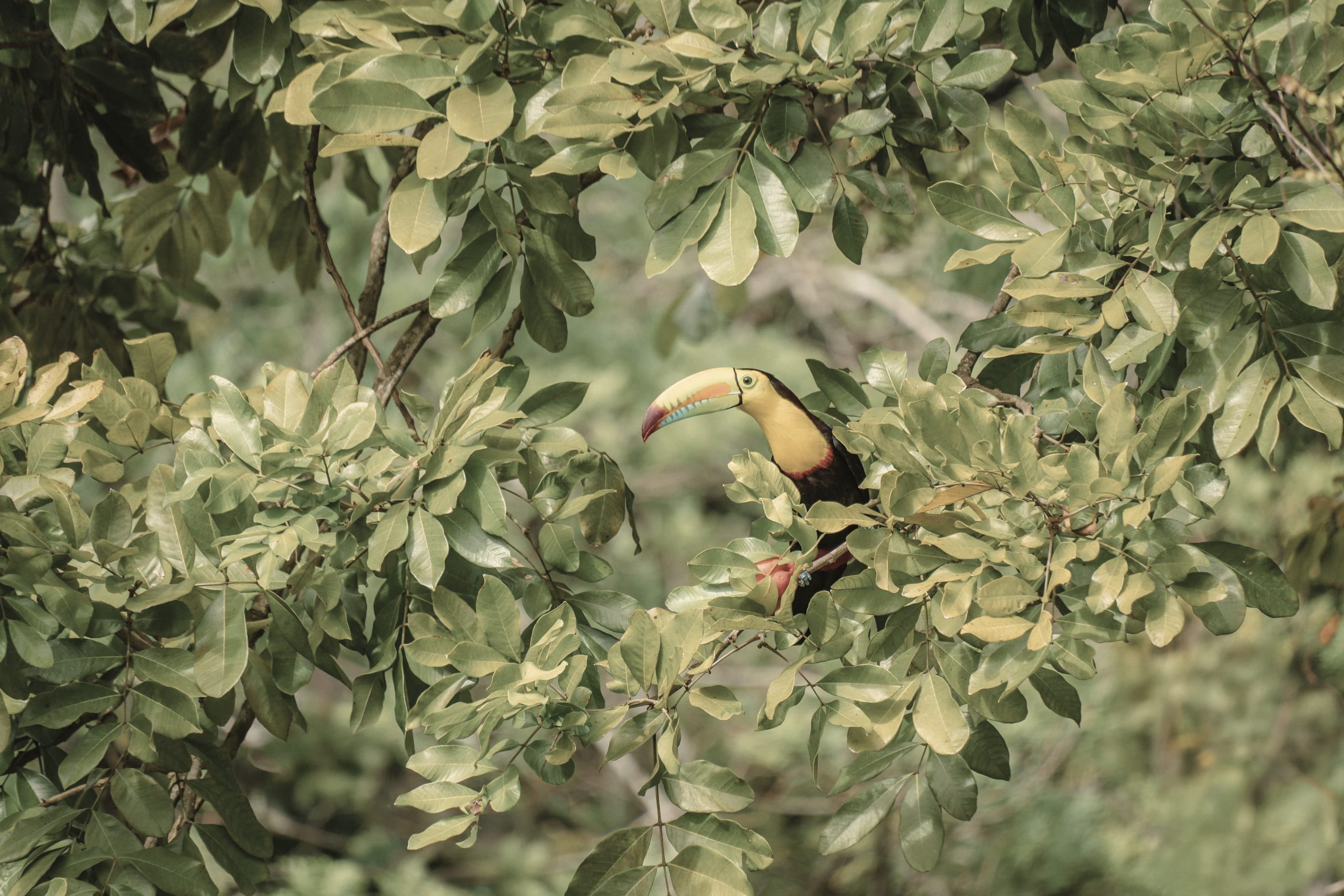
A keel-billed toucan in the leaves, the bigger cousin. The bill runs green with a red tip, and there is no collar.
Side by side the difference is not subtle. The toucan is longer and about twice the weight. Its bill runs 12-15 centimetres, about a third of the whole bird, mostly green with a red tip and orange down the sides. It looks solid and is not: the structure is spongy bone under a shell of keratin. The aracari carries a shorter bill in two flat tones, and the chestnut collar the toucan does not have.
| Collared aracari | Keel-billed toucan | |
|---|---|---|
| Length | 38–41 cm | 42–55 cm |
| Weight | 175–250 g | 380–500 g |
| Bill | pale upper mandible, black tip and culmen, black lower mandible | 12–15 cm, green with red tip and orange sides |
| Nape | narrow chestnut collar | no collar |
| IUCN status | Least Concern | Near Threatened |
Sources: Birds of the World. IUCN Red List assessment, 2020. 2015 Cahuita National Park bird survey.
Both are projected to fall by about 10-19 per cent, the aracari between 2017 and 2031, the toucan over three generations, both of them on habitat loss. The aracari is still listed as Least Concern, because its range is very large. The toucan, national bird of Belize, is already Near Threatened. A big range buys time. It does not replace the forest.
Learning the two apart takes one clear view. After that the aracari is easier, because the aracari is almost never a single bird. One aracari crosses. Then five more. The count goes wrong somewhere around the fourth, because the first ones are already back in the leaves. The whir of the wings lasts longer than the sight of them.
More on the path, the park and what else lives here is on the place page.